

Every day during the season, hundreds of cars drive past St. Brigid's Well on their way to the Cliffs of Moher. Most people don't know it's there. Those who do often assume it's just a quick photo opportunity. But this place has been drawing pilgrims for over 1,500 years, and there's a reason why.
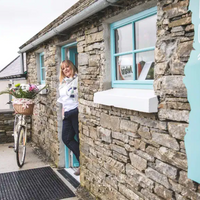
St. Brigid's Well sits right across the road from Moher Cottage. We see it every day, and we never take it for granted.
Who Was St. Brigid?
St. Brigid is one of Ireland's three patron saints, alongside St. Patrick and St. Columba. She lived in the 5th and 6th centuries and founded a monastery in Kildare that became one of the most important religious centres in medieval Ireland.
But Brigid's significance goes deeper than Christianity. Many historians believe the figure of St. Brigid merged with an earlier Celtic goddess of the same name—a goddess associated with fire, healing, poetry, and fertility. The sacred wells dedicated to Brigid around Ireland often predate Christianity, suggesting these were places of pilgrimage long before they became Christian sites.
St. Brigid's feast day is February 1st—Imbolc in the Celtic calendar, marking the beginning of spring. The timing isn't coincidental.
The Well Itself
St. Brigid's Well here beside the Cliffs of Moher is one of dozens of holy wells dedicated to her across Ireland but they say it is the most visited well in Ireland. Like many such sites, it has been a place of pilgrimage for centuries.
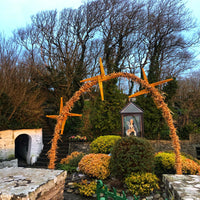
The well is set in a peaceful enclosure with a statue of St. Brigid and a stone altar where visitors leave offerings and prayers. The atmosphere is distinct. Even visitors who aren't religious often comment on the sense of peace and presence at the well. Whether you attribute that to the spiritual significance of the place or simply to the accumulated intentions of thousands of pilgrims over centuries, the effect is real.
The Tradition of Holy Wells
Holy wells are a distinctive feature of Irish spirituality. There are thousands across the island, most dedicated to local saints or associated with healing properties.
The tradition of visiting these wells goes back to pre-Christian Ireland, when natural springs and wells were believed to be entrances to the otherworld. When Christianity came to Ireland, many of these sites were rededicated to saints rather than destroyed, allowing the ancient practices to continue in a new religious context.
People come to holy wells for healing, to leave prayers, to mark significant moments in their lives, or simply to connect with something older and deeper than everyday life. The rituals vary, but common practices include:
- Walking around the well in a clockwise direction (usually three or nine times)
- Leaving offerings
- Saying prayers or making wishes
- Lighting candles
At St. Brigid's Well, you'll see evidence of all these practices.
Why Visit?
It's a counterpoint to the Cliffs. The Cliffs of Moher are dramatic, powerful, overwhelming in their scale and beauty. St. Brigid's Well is intimate, peaceful, contemplative. Together, they represent different aspects of this landscape—the wild natural world and the quiet sacred space.
It connects you to centuries of pilgrims. Standing at the well, you're doing something people have done in this exact spot for over a millennium. That continuity across time is rare and worth experiencing.
It's genuinely peaceful. On a day that the Cliffs are crowded and windswept, St. Brigid's Well is usually quiet. Even in high season, you might have the place to yourself. It's a chance to step out of tourist mode for a few minutes.
It's part of the landscape's story. The Cliffs of Moher don't exist in isolation. This entire area has layers of history and meaning—geological, cultural, spiritual. St. Brigid's Well is part of understanding this place more deeply.
How to Visit
St. Brigid's Well is easy to find. It's right on the main road to the Cliffs of Moher, just across from Moher Cottage. There's room for a couple of cars to park or you can park at our cottage if you're stopping for coffee.
The site is open all the time. There's no fee, no ticket, no visitor centre. It's simply there, as it has been for centuries.
Take your time. There's no rush. Sit for a while. Read the information boards about St. Brigid and the well's history. If you're so inclined, leave an intention or say a prayer. Or just observe the peace of the place.
The Larger Pilgrimage Route
It is said St. Brigid's Well was part of a larger traditional pilgrimage route that also includes the Cliffs of Moher and ends at Hag's Head. Pilgrims would walk the route, stopping at the well before continuing along the cliffs.
Our farm sits along this ancient route, and we have the monument to Cornelius O'Brien right here on our land beside the well—Cornelius know as the father of Irish tourism as he kicked off tourism in this area in the 19th century. If you're interested in the history and heritage of this place, we offer tours that explore these connections.
After Your Visit
After you've visited the well, come across the road to Moher Cottage. We're right here, and we'd love to welcome you. Have a coffee on our terrace with views across Liscannor Bay. Try our handmade fudge. Browse our carefully chosen collection of Irish gifts. We are happy to tell you more about St.Brigid's Well too.
We're part of the fabric of this place, just as St. Brigid's Well is. And we believe that experiencing the Cliffs of Moher—truly experiencing it—means taking time for the quieter places too.
The well will still be here long after we're gone, just as it was here long before we arrived. That's worth honouring.
Caitriona & Kevin, @ Moher Cottage




0 comment